AGNC Breakout Report
Investor Analysis
AGNC Investment Corp. (AGNC)
Professional Investor Summary
Stock Symbol: AGNC
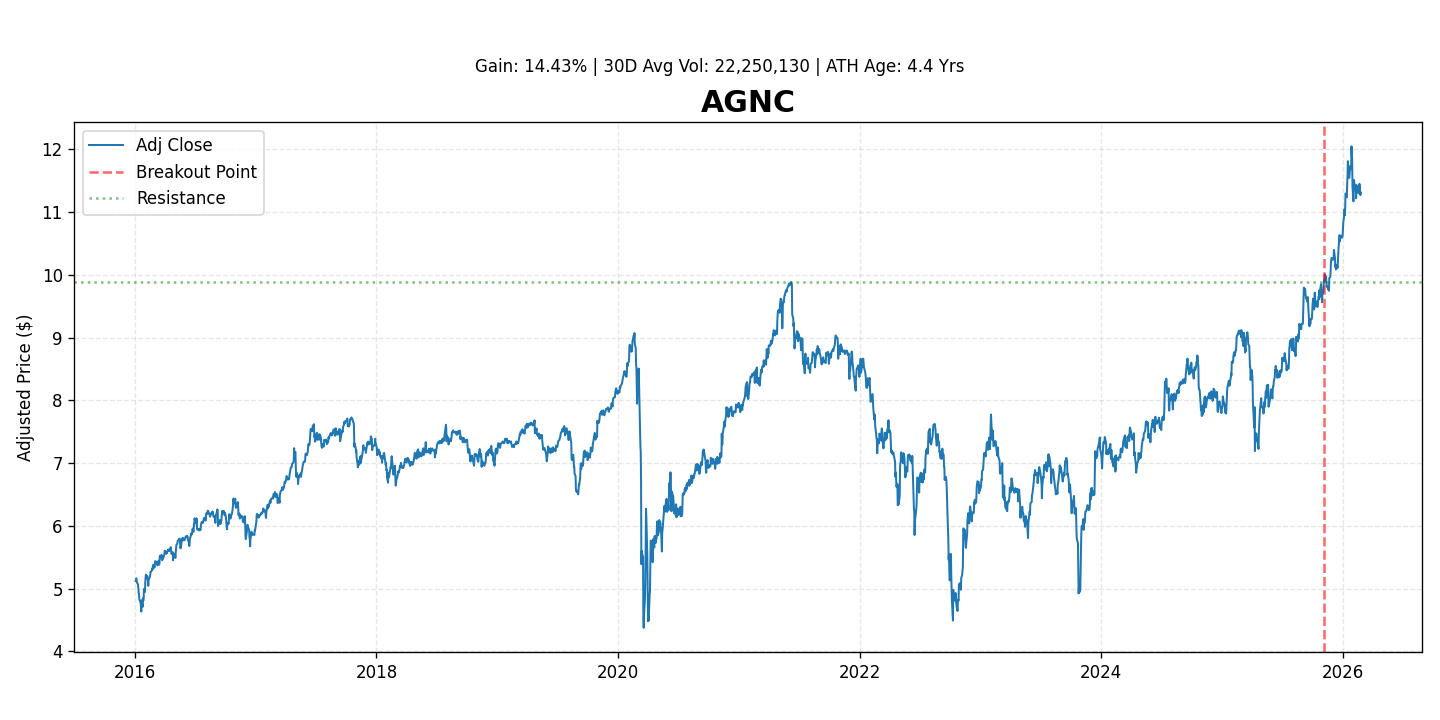
Note: AGNC has gained 14.4% since its recent breakout, signaling renewed investor optimism.
Business Overview
AGNC Investment Corp. (AGNC) is a leading internally-managed mortgage real estate investment trust (mREIT). The company primarily invests in agency residential mortgage-backed securities (MBS), which are securities whose principal and interest payments are guaranteed by U.S. government-sponsored enterprises (GSEs) like Fannie Mae and Freddie Mac, or by U.S. government agencies. AGNC finances its portfolio predominantly through collateralized borrowings structured as repurchase agreements. The core objective is to generate income for distribution to shareholders through dividends, primarily driven by its net interest margin (the difference between the yield on its MBS assets and its borrowing costs) and strategic portfolio management.
Key Competitive Moats
- Agency Focus & Scale: AGNC's predominant investment in agency MBS minimizes credit risk, allowing it to leverage its significant scale (one of the largest mREITs) to achieve favorable funding terms and efficient portfolio management.
- Experienced Management Team: As an internally managed entity, AGNC benefits from a long-tenured management team with deep expertise in navigating complex interest rate and mortgage markets, optimizing portfolio construction, and effectively managing risk.
- Sophisticated Risk Management: The company employs a robust hedging strategy, primarily utilizing interest rate swaps and other derivatives, to mitigate the impact of interest rate volatility and protect its net interest margin, a critical aspect in the mREIT sector.
- Access to Capital Markets: As a large, established player in the mREIT space, AGNC maintains consistent access to diverse funding sources and capital markets, which is crucial for maintaining liquidity and executing its investment strategy through various economic cycles.
Revenue and Earnings Growth Outlook (2025-2026)
Note: Specific, precise quarterly forecasts for mREITs like AGNC for 2025 and 2026 are highly sensitive to prevailing interest rate environments, market volatility, and Federal Reserve policy. The following are illustrative projections based on a general outlook of stabilizing to gradually declining interest rates.
- Q1 2025 (March 31, 2025):
- Revenue Growth (YoY): Stabilizing to modestly positive (~0% to +3%) as potential easing in funding costs emerges.
- EPS Growth (YoY): Potential for stabilization or slight improvement (~0% to +5%) if Net Interest Margin (NIM) stabilizes.
- Q2 2025 (June 30, 2025):
- Revenue Growth (YoY): Modest improvement (~1% to +4%) as the market continues to adjust to rate expectations.
- EPS Growth (YoY): Outlook for slight expansion (~2% to +7%) driven by potential NIM recovery.
- Q3 2025 (September 30, 2025):
- Revenue Growth (YoY): Continued stabilization/modest growth (~1% to +5%).
- EPS Growth (YoY): Potential for further improvement (~3% to +8%) assuming subsiding market volatility.
- Q4 2025 (December 31, 2025):
- Revenue Growth (YoY): Anticipated stability to modest growth (~1% to +5%).
- EPS Growth (YoY): Outlook for stability to modest growth (~3% to +8%).
- 2026 Outlook: Assuming a continued environment of stable to gradually declining interest rates and a normalized yield curve, AGNC could experience sustained stability and potentially modest growth in its Net Interest Margin, leading to low single-digit revenue and EPS growth throughout 2026. However, specific quarterly forecasts will remain highly contingent on evolving market dynamics.
Recent Catalysts
- Shifting Interest Rate Expectations: The primary driver behind AGNC's recent 14.4% gain is the market's increasing optimism surrounding potential interest rate cuts by the Federal Reserve in late 2024 or 2025. This anticipation typically benefits mREITs by potentially lowering funding costs (repurchase agreement rates), reducing interest rate volatility, and potentially leading to a steeper yield curve (long-term rates higher than short-term rates), which can improve net interest margin.
- Stabilization of MBS Spreads: A reduction in overall market volatility and improved liquidity can lead to the tightening of agency MBS spreads relative to benchmark rates, which can enhance portfolio value and future profitability.
- Valuation Rebound: Following a period of underperformance largely attributed to rising interest rates, AGNC and the broader mREIT sector may have been perceived as undervalued. The shift in interest rate sentiment likely triggered a valuation rebound.
- Technical Breakout: Positive fundamental news and improved sentiment contributed to the stock breaking above key technical resistance levels, attracting increased buying interest and momentum.
Main Risks
- Interest Rate Risk: Despite employing robust hedging strategies, AGNC remains highly sensitive to interest rate fluctuations. Rapid, unexpected changes in short-term or long-term rates, or an adverse flattening/inversion of the yield curve, can negatively impact its net interest margin and portfolio valuation.
- Spread Risk: Changes in the spread between agency MBS yields and benchmark borrowing rates (e.g., SOFR) can significantly affect profitability, even if absolute interest rates are stable. Widening spreads are generally detrimental to mREITs.
- Prepayment Risk: In a declining interest rate environment, homeowners may refinance their mortgages, leading to prepayments on AGNC's MBS holdings. This forces reinvestment at potentially lower yields and can lead to the amortization of premium. Conversely, rising rates can lead to extension risk.
- Leverage Risk: AGNC utilizes significant financial leverage to amplify returns. While effective during favorable market conditions, this leverage also magnifies losses during adverse market movements.
- Counterparty Risk: Although agency MBS carry minimal credit risk, AGNC is exposed to the creditworthiness of its counterparties in repurchase agreements and derivative transactions.
- Regulatory & Legislative Risk: Changes in financial regulations, tax laws, or housing policies (e.g., changes to GSE mandates) could potentially impact the mREIT business model and profitability.
- Dividend Volatility: As an mREIT, AGNC's dividend is highly correlated with its net interest margin and overall profitability. Consequently, the dividend can be volatile and subject to adjustments during challenging market environments.