WDC Breakout Report
Investor Analysis
Western Digital (WDC) - Investor Summary
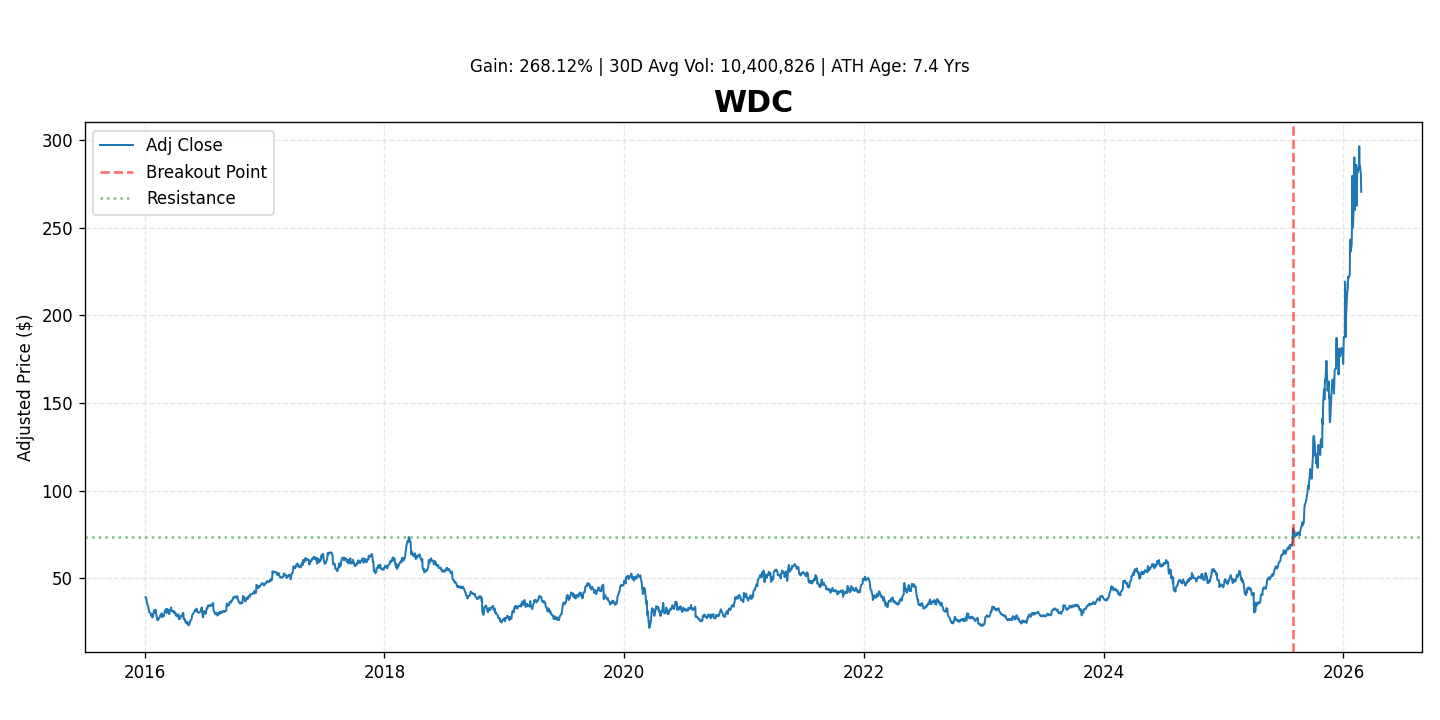
Note: The stock has experienced a significant run-up, gaining approximately 268.1% since its breakout, reflecting strong market optimism regarding its recovery and strategic initiatives.
Business Overview
Western Digital Corporation (WDC) is a global leader in data storage solutions, developing and manufacturing a broad range of products and technologies. The company operates primarily through two segments: Flash and HDD (Hard Disk Drive). The Flash segment offers NAND flash-based products, including solid-state drives (SSDs) for enterprise, client, and consumer applications, as well as embedded flash solutions. The HDD segment provides high-capacity drives for enterprise data centers (especially critical for AI workloads), client computing, and consumer electronics.
Key Competitive Moats
- Proprietary Technology & IP: Extensive patent portfolio in both HDD and NAND flash technologies, covering design, manufacturing processes, and data management. This includes advanced storage architectures vital for next-gen data centers.
- Economies of Scale: As one of only two major independent HDD manufacturers and a top-tier NAND flash producer, WDC benefits from massive scale in R&D, manufacturing, and supply chain, leading to cost efficiencies and market dominance.
- Established Customer Base: Deep relationships with leading enterprise customers, cloud service providers, OEMs, and consumer electronics brands globally, ensuring consistent demand for high-capacity and high-performance storage.
- Manufacturing Complexity: Both HDD and NAND flash production involve highly complex, capital-intensive manufacturing processes that create significant barriers to entry for new competitors.
Revenue and Earnings Growth (Analyst Estimates)
Analysts project a significant turnaround and strong growth for Western Digital in 2025 and 2026, driven by a recovery in the memory market and robust demand for high-capacity storage, particularly from AI and cloud data centers. These are forward-looking estimates and subject to market conditions.
- Q1 2025 (Calendar Quarter ending March 31, 2025): Revenue estimated to grow 15-20% YoY, with EPS potentially turning positive or significantly improving QoQ.
- Q2 2025 (Calendar Quarter ending June 30, 2025): Revenue estimated to grow 20-25% YoY, with further expansion in gross margins and positive EPS.
- Q3 2025 (Calendar Quarter ending September 30, 2025): Revenue estimated to grow 25-30% YoY, demonstrating accelerating recovery and stronger profitability.
- Q1 2026 (Calendar Quarter ending March 31, 2026): Continued robust growth, with revenue estimated in the 20-25% YoY range and strong double-digit EPS growth as the market normalizes and strategic initiatives bear fruit.
Recent Catalysts
- Memory Market Recovery: The cyclical downturn in NAND flash and HDD markets appears to be bottoming out, with increasing pricing power and demand, leading to improved gross margins.
- AI-Driven Demand: Surging demand for high-capacity HDDs and high-performance enterprise SSDs from AI training and inference data centers provides a substantial growth vector for both segments.
- Spin-Off Progress: WDC's ongoing plans to separate its Flash (NAND) and HDD businesses could unlock significant shareholder value by allowing each entity to pursue tailored strategies and attract dedicated investment capital.
- Product Innovation: Introduction of next-generation HDDs (e.g., ePMR, OptiNAND) and advanced enterprise SSDs that meet the evolving performance and capacity requirements of hyperscale cloud and enterprise customers.
Main Risks
- Cyclicality of Memory Market: The NAND flash and HDD markets are inherently cyclical, prone to oversupply and price volatility, which can severely impact profitability.
- Intense Competition: Fierce competition from well-capitalized rivals like Samsung, Kioxia (NAND), and Seagate (HDD) could limit pricing power and market share gains.
- Geopolitical Risks: Significant manufacturing operations and supply chain exposure in Asia, making WDC vulnerable to geopolitical tensions, trade disputes, and supply chain disruptions.
- Execution Risk of Spin-Off: The successful separation of the Flash and HDD businesses requires complex execution, and any delays or unfavorable market conditions could impact the perceived value creation.
- Technological Obsolescence: Rapid advancements in storage technologies, including new memory types, could potentially disrupt existing product lines if WDC fails to innovate quickly enough.